 Minesweeper100
Minesweeper Patterns
A Minesweeper pattern is a group of numbers along the edge of the open area that has only one answer, so you can place its mines on sight. Learn 1-1 and 1-2 first, because the common patterns are built from them: in a 1-2-1 the mines face the 1s, in a 1-2-2-1they face the 2s, and in a 2-1-2 they face the 1 and sit just outside each 2. A pattern is guaranteed when its numbers touch no other closed squares, apart from mines you already know.
This guide is for players who know what the numbers mean and want to read the board faster. It shows each straight-edge pattern and the two corner patterns on a board, along with the rows that look like patterns but prove nothing and the way bigger numbers reduce to a pattern you know. Three practice boards follow the sections. If you are new to the numbers, start with how to play.
Contents
What a pattern is
Authoritative Minesweeper defines a pattern as "a common arrangement of numbers with only one solution", and says learning them matters "because thinking wastes time".1 Minesweeper Online puts it the same way: "If you memorise a pattern it will reduce the amount of time you use thinking."2
Two numbers next to each other share some of their closed squares, and comparing what each one needs settles the squares only one of them touches. Once you know a pattern, you see the result of that comparison without working through it.
A pattern is named by its numbers read along the edge, so a 1-2-1 is a 1, a 2 and a 1 side by side. Authoritative Minesweeper adds an X for the square the pattern settles, as in 1-2-X and 1-1-X.1 Minesweeper Online gives variants short codes, such as 1-2+ for a 1 next to a larger number and 1-2-1R for a 1-2-1 found by reduction.2
How to read the boards
Each board shows a piece of an edge, with the closed squares on top and the pattern's numbers, tinted blue, below them. Patterns work the same turned on their side or upside down.
- Green with a ring: proven safe.
- Red with a mine: proven to be a mine.
- Plain: these numbers alone cannot settle it.
- Faded: already open; its number does not matter here.
- Thick black line: the edge of the board. On other sides the board carries on.
Patterns at a glance
Read each row along a straight edge: one row of closed squares in front of the numbers, and the squares beside the numbers already open. "Facing" means the closed square straight in front of a number; "past" means the next one along, beyond the end of the pattern. Players often write the names without dashes, as 121, 1221, 212, 2112, 111 or 222.
| Pattern | Mines | Safe |
|---|---|---|
| 1-1 from a wall | None settled | The square past the second 1 |
| 1-2 | The square past the 2 | The square past the 1 |
| 1-2-1 | Facing both 1s | Facing the 2, and past each 1 |
| 1-2-2-1 | Facing both 2s | Facing and past each 1 |
| 2-1-2 | Facing the 1, and past each 2 | Facing both 2s |
| 2-1-1-2 | Facing and past each 2 | Facing both 1s |
| 1-2-2-2-1 | Facing the middle 2 | Past each 1; the rest is undecided |
| 1-1-1, 2-2-2 | None | None, on a flat edge |
| 1-3-1 corner | The outside corner | The far square of each arm |
| 2-2-2 corner | The far square of each arm | The outside corner |
1-1 and 1-2: the two rules
Authoritative Minesweeper calls 1-2-1 and 1-2-2-1 "combinations of a more important pattern", 1-2-X, and names 1-1-X as "the other important pattern".1 Minesweeper Online builds its list the same way,2 so these are the two to learn first.
1-1 from a wall: the third square is safe
Picture two 1s side by side, where the first 1 touches only two closed squares because the edge of the board stops the row. The first1 says its mine is in those two squares. The second 1 touches both of them too, so its one mine is already there, and the third square it touches is safe.1, 2 A square that is already open stops the row just as well: our solver gives the same answer when the first 1's other neighbour is open instead of off the board.
Without a wall, two 1s settle nothing. In the middle of a long edge each touches three closed squares, and the mine can be in either square they share, or there can be two mines, one past each 1.
1-2: the square past the 2 is a mine
Now a 1 next to a 2 on a straight edge. The 2 touches three closed squares and needs two mines. Two of those three squares also touch the 1, so they hold at most one mine. The other mine has to be in the third square, the one only the 2 touches. Authoritative Minesweeper puts it as "When you see 1-2-X on a row the X is always a mine".1
It settles a second square too. The squares the 1 and the 2 share now hold exactly one mine, which is all the 1 needs, so the square past the 1 on the other side is safe.
The same reasoning works with bigger numbers. Minesweeper Online shows a 1 next to a 4: the squares they share can hold at most one mine, because of the 1, so the 4's other three mines fill the three closed squares only the 4 touches.2
1-2-1 pattern
1-2-1 is a 1-2 read from both ends.1, 2 From the left, the square past the 2 is a mine; from the right, the square on the other side of the 2 is a mine. Those are the squares facing the two 1s. The 2 then has both its mines, so the square facing it is safe, and each 1 already has its mine, so the square past each 1 is safe too.
Here is one three clicks into an Intermediate game on this site. The top edge of the opening reads 1-1-2-1-2, and the 1-2-1 in the middle of it settles five squares: mines facing its two 1s, and safe squares facing the 2 and just past each 1. The numbers at either end do not change that, because each number of the 1-2-1 touches only the three closed squares in front of it.
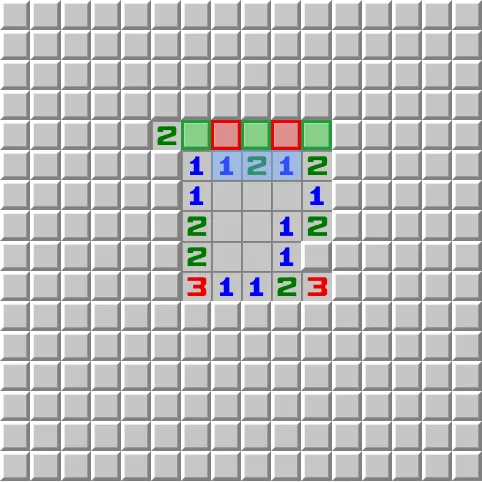
One answer on Puzzling Stack Exchange says "it is very rare to actually encounter a 1-2-1 specifically. Usually, these are by reduction from surrounding mines."3 On this site's boards a plain one is not that rare. When the solver played 1,000 games per level, a 1-2-1 on a flat edge, its numbers touching no other closed squares, showed up at some point in 7.5% of Beginner games, 26.9% of Intermediate games and 34.9% of Expert games. A plain 1-2-2-1 was rarer, in 6.0% of Expert games. A player who opens squares in a different order will see different positions, so treat these as rough rates. Reduced versions, such as a 2-3-2 next to a known mine, are covered under reduction.
1-2-2-1 pattern
1-2-2-1 is two 1-2s facing each other. The 1-2 on the left puts a mine facing the second 2; the 1-2 on the right puts a mine facing the first 2.1, 2 Each 2 then has its two mines, so the squares facing the 1s are safe, and so are the squares just past them.
Keep the two apart: in 1-2-1 the mines face the 1s, in 1-2-2-1 they face the 2s. On the first practice board the 1-2-2-1 starts at the edge of the board.
The practice boards start in the middle of a game, with the mines hidden and flags off. Click only squares you can prove are safe: a wrong click loses. On a phone, tap to open. The Show button plays the shortest route one click at a time and explains each click.
Practice 1 of 3 A 1-2-2-1 from the edge of the board
Flags are off and the mines are hidden. Open every safe square with left clicks, and click only squares you can prove are safe. The fewest is 3 clicks.
Your clicks00 left · 0 right · 0 chord
Answer
Fewest clicks: 3 clicks.
- Left click at row 1, column 1: row 2 starts 1-2-2-1. The mines face the two 2s, in row 1, columns 2 and 3, so the square facing the first 1 is safe.
- Left click at row 1, column 4: the square facing the second 1 of the 1-2-2-1 is safe too.
- Left click at row 1, column 5: the 1 in column 4 already has its mine in column 3, so this square, which it also touches, is safe. The last mine is in the corner.
The 1-2-2-1 works with its first 1 against the edge of the board: the mines still face the 2s, and the squares facing the 1s are safe. Its last 1 then clears one more square.
2-1-2 and 2-1-1-2 patterns
With the 1s and 2s swapped, the mines sit further out. In a 2-1-2, read each 2 with the 1 beside it as a 1-2: the square past each 2 is a mine. Each 2 then needs one more mine, and the 1 allows only one among the three squares it touches, so both 2s must share it: the square facing the 1. That makes three mines, facing the 1 and just past each 2, and the squares facing the 2s are safe.
In a game it can just as well run down a column. Seven clicks into this Intermediate game, a 2-1-2 stands on the right edge of the opening, and each of its numbers touches only the three closed squares to its right. The square beside the 1 and the squares above and below the pattern are mines; the squares beside the two 2s are safe.
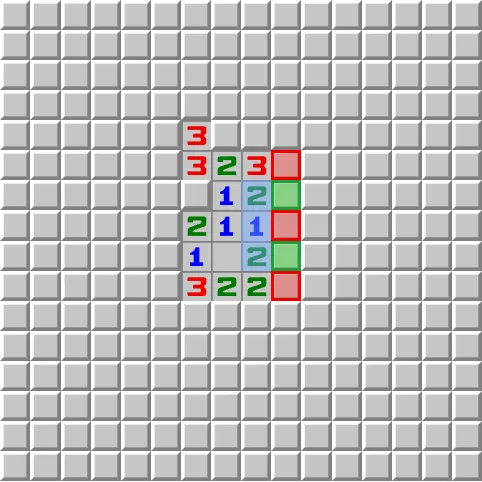
2-1-1-2 works the same way at the ends: each is a 1-2, so the square past each 2 is a mine. Each 2 needs one more mine, facing it or facing the 1 beside it. A mine facing a 1 would touch both 1s and fill them, leaving the far 2 one short. So the mines face the 2s, and the squares facing the 1s are safe.
Practice 2 of 3 Find the 2-1-2
Flags are off and the mines are hidden. Open every safe square with left clicks, and click only squares you can prove are safe. The fewest is 4 clicks.
Your clicks00 left · 0 right · 0 chord
Answer
Fewest clicks: 4 clicks.
- Left click at row 1, column 3: row 2, columns 3 to 5, reads 2-1-2. Its mines face the 1 and sit just outside each 2, in row 1, columns 2, 4 and 6. The squares facing the 2s are safe; this is one.
- Left click at row 1, column 5: the other square facing a 2.
- Left click at row 1, column 1: the 1 in row 3, column 1 touches one closed square, row 2, column 1, so that is a mine. With it and the mine in row 1, column 2, the 2 in row 2, column 2 is full, so this corner is safe.
- Left click at row 1, column 7: the same on the right: the 1 in row 3, column 7 puts a mine in row 2, column 7, and the 2 next to it is full.
The 2-1-2 settles five squares on its own: three mines and two safe squares. The 2s in columns 2 and 6 also touch a square at the end of row 2, so they need the 1s below them to finish the corners.
Rows that settle nothing
On a flat edge, a 1-1-1 fits three layouts: one mine facing the middle 1, or two mines, one facing an end 1 and one past the other end. A 2-2-2 fits three as well, with three or four mines. Neither proves a single square on its own, so look at the numbers around them, or at mines you already know, before you click.
1-1-1 on a flat edge.
2-2-2 on a flat edge.
A row of 1s that starts at a wall does settle squares. It begins with a 1-1, so the third square is safe, and the reasoning repeats along the row: the third, the sixth and every third square after that are safe.
Some longer rows settle only part of the edge. In a 1-2-2-2-1, each end is a 1-2, which puts a mine facing the middle 2 and makes the square past each 1 safe. The four squares facing the 1s and the outer 2s hold the other two mines in one of two ways, and these numbers cannot tell which. The squares beyond the ends are not settled either.
Corner patterns
Where the open area has an inside corner, a row of numbers meets a column of numbers and the closed squares wrap around the outside. The number in the corner touches five closed squares: two along each arm and the outside corner square diagonal to it. Minesweeper Online lists two patterns here.2
1-3-1 corner.
2-2-2 corner.
1-3-1 corner
A 3 in the corner with a 1 beside it on each arm. Each 1 shares two of the 3's squares, so each pair holds at most one mine, and the 3's third mine has to be the outside corner. The 3 then needs one mine in each pair, which gives each 1 its mine, so the far square each 1touches is safe.
2-2-2 corner
The same shape with 2s. Each arm's 2 touches the pair next to the corner and one far square, so each pair holds at least one mine. That is already two mines for the corner 2, so the outside corner is safe, each pair holds exactly one mine, and each arm's far square is a mine. The two corner patterns are opposites: the 1-3-1 corner puts a mine on the outside corner and makes the far squares safe, and the2-2-2 corner does the reverse.
Two pattern pages we read get this one wrong. Minesweeper.now says "the single inner corner cell is a mine; all others are safe",4 and Minesweeper Blast says every closed square next to the 2s "must be a mine".5 The corner 2 touches five closed squares and has only two mines, and the arms account for both.
Pattern reduction
Larger numbers often reduce to a pattern. Authoritative Minesweeper's rule: "You simply subtract the known mines from each number. For example, if you flag a mine touching a 3 it becomes a 2."1 Then read the smaller numbers as a pattern.
The flag below the 3 touches all three numbers, so each one needs one mine fewer from the closed row: 2-3-2 becomes 1-2-1. The same works without flags, as long as you know where the mines are. On the board below, the 1s in the bottom row each point to a mine at the end of the 2-2-2.
Practice 3 of 3 A 2-2-2 that is really a 1-2-1
Flags are off and the mines are hidden. Open every safe square with left clicks, and click only squares you can prove are safe. The fewest is 3 clicks.
Your clicks00 left · 0 right · 0 chord
Answer
Fewest clicks: 3 clicks.
- Left click at row 1, column 1: the 1 in row 3, column 1 touches one closed square, so row 2, column 1 is a mine; the 1 in row 3, column 5 does the same on the right. Subtract each from the 2 next to it and row 2 reads 1-2-1, so the mines face the 1s, in row 1, columns 2 and 4. The 2 in row 2, column 2 then has both its mines, and this corner is safe.
- Left click at row 1, column 3: the square facing the 2 of the 1-2-1 is safe.
- Left click at row 1, column 5: the other corner, the same way as the first.
Read as it stands, 2-2-2 settles nothing. Once the two mines at the ends of row 2 are taken away, it is a 1-2-1 with one answer.
Reduce only with mines you have proven. A wrong flag makes the numbers next to it read lower than they really are.
How often you need them
We let a solver play 20,000 of this site's Classic boards per level from a random first click. At each step it took the simplest sure move it could find, a square opened or a mine marked, and we recorded which of three kinds of reasoning settled it:
- One number on its own: its closed squares are all mines, or it already has all its mines.
- Two numbers, one inside the other: every closed square of one also touches the other. 1-1 from a wall works this way.
- Anything wider. A 1-2 on a flat edge, 1-2-1, 1-2-2-1, the corners and counting the mines left are all here.
| Level | One number | Two numbers, one inside the other | Wider |
|---|---|---|---|
| Beginner | 95.9% | 3.6% | 0.5% |
| Intermediate | 97.3% | 2.3% | 0.4% |
| Expert | 94.4% | 4.8% | 0.9% |
A single number settles about 19 moves in 20. The rest decide whether a board can be finished at all: here is the share of boards the solver cleared without a guess when it was allowed each kind of reasoning.
| Level | One number only | Adding one-inside-the-other pairs | Every kind |
|---|---|---|---|
| Beginner | 59.1% | 81.6% | 90.3% |
| Intermediate | 23.1% | 53.6% | 70.4% |
| Expert | 0.07% (15 boards) | 4.4% | 15.3% |
On Expert, reading single numbers cleared 15 boards in 20,000. Adding the comparison of a number with one whose closed squares it covers raised that to about 1 in 23, and wider reasoning, which includes most patterns on this page, to about 15%. The rest of the Expert boards reached a point where the numbers settle nothing and a guess is needed, which the guessing guide covers. Even on Beginner, a player who only counted single numbers would get stuck on 4 boards in 10.
Practising on Minesweeper100
- No Guess deals only boards the solver can finish without guessing, so every stuck spot has a pattern or a count that settles it.
- On the No Guess page, the Hint button marks the next square you can prove, tints the numbers that prove it, and says which kind of reasoning it took: one number, two numbers compared, or every way the mines can lie. A game with a hint does not count for your best time.
- In Classic games, some spots have no pattern at all. When the numbers cannot settle any square, the guessing guide covers how to pick the safest one.
- Once you see patterns quickly, the chording guide shows how to clear around their mines in one click, and the tips page covers the habits around them.
Summary
A pattern is a row of numbers with one answer. Two rules make most of them: 1-1 from a wall makes the third square safe, and 1-2 puts amine on the square past the 2. From those, a 1-2-1 has its mines facing the 1s, a 1-2-2-1 facing the 2s, a 2-1-2 facing the 1 and past each 2, and a 2-1-1-2 facing and past each 2. 1-1-1 and 2-2-2 on a flat edge settle nothing alone. In a corner, 1-3-1 makes the outside square a mine and 2-2-2 makes it safe. When numbers are bigger, subtract the mines you know and look again.
Questions
What are the patterns in Minesweeper?
A pattern is a group of numbers along the edge of the open area with only one answer, so you can place its mines without working them out. The ones to learn first are 1-1 and 1-2, and the patterns built from them: 1-2-1, 1-2-2-1, 2-1-2 and 2-1-1-2. Minesweeper Online lists two corner patterns as well, 1-3-1 and 2-2-2. Larger numbers often turn into one of these once you subtract mines you already know.
What is the 1-2-1 pattern?
Three numbers, 1, 2 and 1, in a row along a straight edge of closed squares. The mines are on the squares facing the two 1s. The square facing the 2 is safe, and so is the square just past each 1.
What is the 1-2-2-1 pattern?
Four numbers, 1, 2, 2 and 1, in a row along a straight edge. The two mines are on the squares facing the 2s. The squares facing the 1s are safe, and so is the square just past each 1.
What is the 2-1-2 pattern?
Three numbers, 2, 1 and 2, in a row along a straight edge. There are three mines: one facing the 1 and one just past each 2. The two squares facing the 2s are safe.
Do Minesweeper patterns work vertically?
Yes. A number counts the eight squares around it the same way in every direction, so a pattern works along a column, along a row, or upside down. The edge has to be straight, and the numbers should touch no other closed squares apart from mines you already know. Inside corners have their own patterns.
Is there a pattern to where the mines are placed?
No. In Classic Minesweeper the mines are placed at random. On Minesweeper100 they are placed after your first click, with that square and the eight around it kept clear. Patterns are in the numbers you uncover, not in where the game puts mines.
How we checked
We read every source below on November 19, 2026. Minesweeper Online's help page needs JavaScript, so we read it in a browser.
Every board on this page is drawn when the site is built, from a fixed set of mines and the game's own rules. A solver then lists every closed square the blue numbers prove, using those numbers only, and the build stops if that list differs from the squares the text marks. That is how we know, for example, that 1-1-1 on a flat edge proves nothing and that the 2-2-2 corner's outside square is safe.
A test confirms that each practice board can be cleared with clicks that are all provably safe when they are made, and that each route shown is the shortest. The two tables in "How often you need them" come from playing the site's own Classic generator with the solver the Hint uses, with the same random numbers and first clicks as the guessing guide. The "every kind" column matches that guide's count of boards that need no guess, except on Expert, where the Hint's longer search cleared 3 more boards (3,050 against 3,047). Boards the solver gave up on count as needing a guess. The 1-2-1 and 1-2-2-1 rates come from another 1,000 games per level played the same way, checking the whole board for a plain pattern after every move.
Page history: first published November 19, 2026. If you spot a mistake, write to contact@play100.io with the name of this page.
Sources
- "Minesweeper Strategy - Patterns", Authoritative Minesweeper, read November 19, 2026
- "Patterns", Minesweeper Online help, read November 19, 2026
- "What frequent patterns can be used to overcome Minesweeper obstacles?", Puzzling Stack Exchange, May 22, 2014, read November 19, 2026
- "Minesweeper Patterns: 1-1, 1-2-1, 1-2-2-1", Minesweeper.now help, read November 19, 2026
- "2-2-2 Corner Pattern in Minesweeper (222)", Minesweeper Blast, read November 19, 2026